
Daily Living UK · UK Guide 2026
Camping Lantern or Head Torch?
Updated 9 September 2026 · 2,564 words
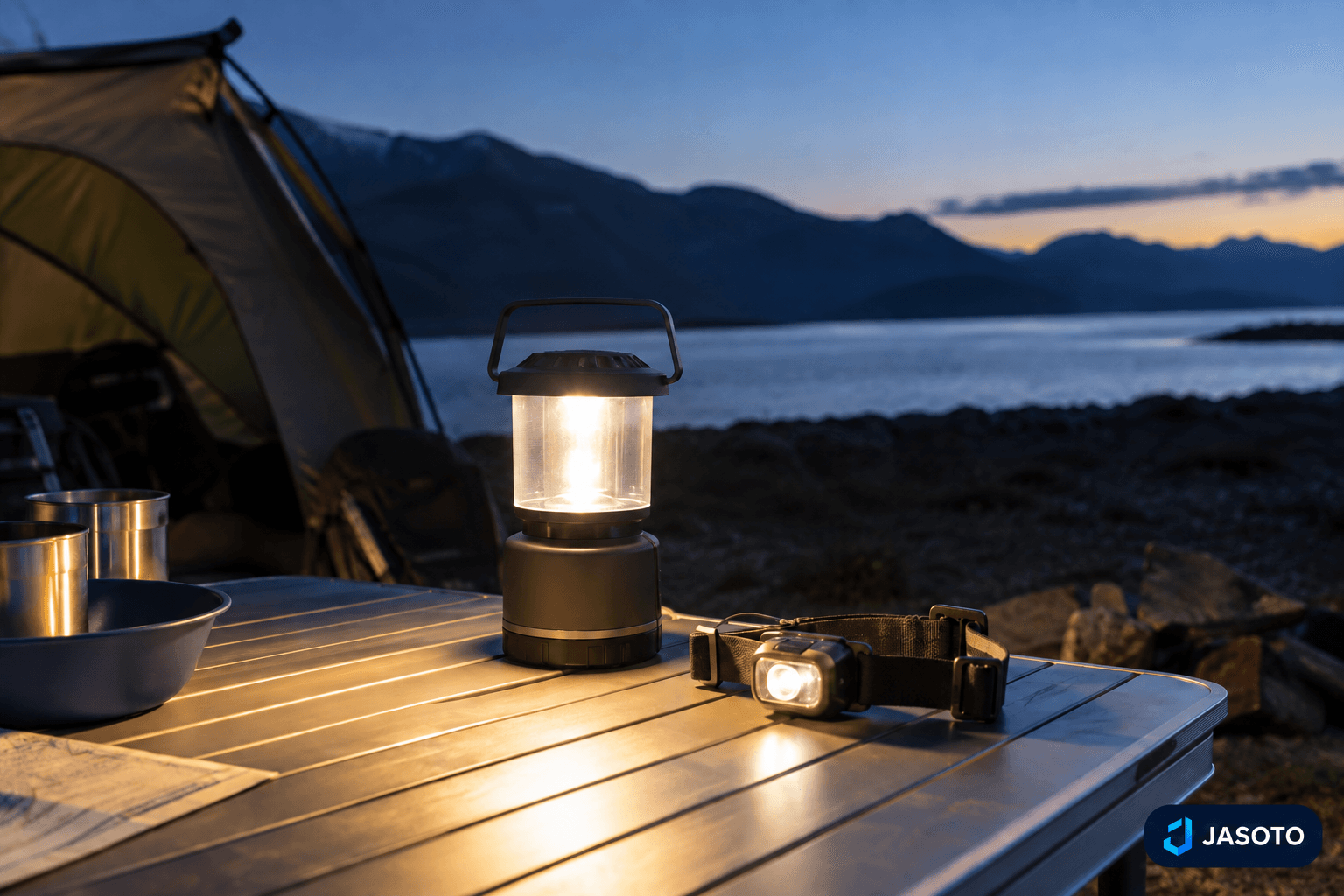
AI-generated illustrative image. It does not depict an actual customer project or a tested product.
A camping lantern and a head torch are both simple pieces of kit, but they solve different lighting problems. A lantern spreads light across a shared area, while a head torch follows where you look and keeps your hands free. That distinction matters more than the brand or the headline brightness figure, because the right choice depends on what you will actually be doing after dark.
If you are planning a campsite meal, reading in a tent, sorting gear at a table or sitting with other people, a lantern can make the space easier to share. If you are finding items in a bag, walking to the facilities, pitching in fading light or packing away while one hand is occupied, a head torch is often the more useful tool. Many people do not need every possible lighting format; they need a sensible mix that fits the trip.
The best way to decide is to work from your own routine rather than from a shopping list. Consider the tasks you will do, how long you will be away, whether you can recharge or replace batteries, and how much kit you are prepared to carry. Once you look at lighting in that order, it becomes much easier to see whether you need one main light, one backup or a small combination of the two.
At a glance
- Lanterns are usually best for shared, area lighting such as tents and tables.
- Head torches suit hands-free tasks, short walks and close work in the dark.
- Runtime, beam shape and adjustability matter as much as headline brightness.
- A simple, tested backup is more useful than carrying more lighting formats than you need.
Start with the tasks you need to light
The quickest way to narrow the choice is to think about the actual moments when light matters. A lantern is helpful when several people need to see the same area or when you want a gentle spread of light over a table, tent interior or group activity. In those situations, the point is not to illuminate every corner as brightly as possible, but to make the space usable without creating harsh glare. A stable base or a suitable hanging point can make a lantern much easier to place well, especially if your setup changes from one campsite to another.
A head torch is better when the task is close to your hands or when you need to move around without carrying a lamp. Finding equipment, walking to campsite facilities or packing a bag in the dark are all easier when the light follows your gaze. Fit and controls matter here, because a head torch that slips, feels awkward or is difficult to adjust quickly can become frustrating. It is also worth remembering that a head torch is a personal light, so it should be aimed with care when other people are nearby.
Think about shared light versus personal light
The biggest practical difference between these two formats is not simply where the light lands, but who benefits from it. A lantern creates a shared pool of light, which can make conversation, food preparation and evening organisation feel calmer and more coordinated. If you are travelling with family or friends, one well-placed lantern may reduce the need for everyone to use their own torch for every small task. That can be useful because it keeps the campsite less cluttered and makes it easier to know where the main light source is.
A head torch serves a different purpose. It is the light you wear when your hands need to stay free and when your attention is on a specific job. That makes it well suited to solo tasks, quick check-ins and short walks. It also helps when you want to avoid lighting up the whole area just to do one small thing. The decision between the two often comes down to whether you are lighting a place or lighting a task. For many campers, that difference is enough to decide which format should be the primary one in the bag.
Look beyond brightness figures
It is easy to focus on the brightest advertised setting, but that does not tell the whole story. A light can sound impressive on paper and still be awkward in use if its runtime is too short for the way you camp. What matters is the relationship between output and duration. A short burst of high light may be useful, but it is not the same as having comfortable illumination for an evening of reading, cooking or tidying up. When you compare products, look at the stated runtime at each setting and ask whether that matches your actual routine.
Beam shape matters too. A wide beam spreads light over a broader area and is useful for nearby tasks, while a more concentrated beam serves a different purpose. Neither is universally better; the right choice depends on whether you need coverage or focus. Manufacturer ratings are based on specific test conditions, so it is sensible to leave a practical margin in your power plan. In plain terms, that means not assuming the best-case figure will reflect every real campsite situation, especially if the light is used more frequently or more intensely than the simple specification suggests.
Choose settings that suit tents, tables and walking routes
A lantern often makes most sense in enclosed or semi-enclosed spaces where softer, adjustable light is more comfortable than a fixed, very bright setting. Inside a tent, for example, a strong beam can feel intrusive, while a gentler level may be enough for reading or sorting kit. At a table, adjustable output can help you keep the area lit without making it unpleasant for the people sitting around it. If you expect to use one light for several different tasks, being able to change the setting is more practical than relying on a single mode that is either too dim or unnecessarily bright.
A head torch is usually chosen for movement and close work, so its usefulness depends on how cleanly and comfortably it lights the path in front of you. Walking to a facilities block, checking a guy line or finding something that has rolled under a seat all benefit from a beam that points where your eyes point. If you are comparing options, think not only about output but also about how the light is controlled and how easy it is to switch between modes without fuss. Small details such as the position of the button or the feel of the strap can matter more than people expect once it is dark and you want the light on quickly.
Plan power before you leave home
Lighting is one of the easiest parts of camping to overlook until the end of the day, which is why power planning should happen before you pack. Check charging connections, cables, battery type and the likely opportunities you will have to recharge. Then test the light and its controls before you leave, rather than discovering at the campsite that a button is awkward or a cable is missing. It is also sensible to carry a suitable backup for the trip instead of assuming a phone torch will cover every need.
Solar charging may be useful on some products, but it should be treated with care. Its performance depends on the product and the conditions, so it should not be your only plan unless the manufacturer guidance clearly supports that approach. A good rule is to choose the power source that matches the trip you are taking, not the one that sounds convenient in theory. If you are away for longer or expect limited recharging opportunities, your margin for error is smaller, which makes a tested and familiar setup more important than a clever one.
Build a backup that is easy to reach
A useful lighting plan is not just about the main item you intend to use; it is also about how quickly you can reach a backup if something runs flat or gets misplaced. Keep a light where you can find it immediately on arrival, rather than burying it beneath other gear. If your backup depends on batteries or charging accessories, store those items together and protect them appropriately so they stay usable when needed. In the dark, organisation matters as much as specification because even a reliable light is of little use if you cannot locate it fast enough.
This is also where common sense can prevent small frustrations. If one person in the group is using a head torch and another is relying on a lantern, it helps to know who is carrying what and where it is stored. A simple backup arrangement may be enough for a short overnight stay, while a longer trip may justify a more careful split between primary and secondary light sources. The aim is not to carry more than necessary; it is to make sure a lighting failure does not become a bigger problem than it needs to be.
Match the kit to the size and style of the trip
For a family campsite or a shared pitch, a lantern plus a personal head torch can be a sensible combination. The lantern handles the common area, while each person still has hands-free light for individual tasks. That setup works well when people are moving between a table, tent and facilities, because it covers both group use and quick personal jobs without asking one device to do everything. It also reduces the temptation for everyone to use a strong personal beam when a softer shared light would be more comfortable.
For a short solo trip, the answer may be simpler. One suitable head torch and a backup may cover most tasks if you are mainly on your own and do not need to light a communal space. That does not make a lantern unnecessary in every solo case, but it does mean you should think about actual use rather than assuming both formats are required. The key comparison is not which product is generally better; it is which arrangement gives you the light you need with the least fuss and the least extra gear.
Use water-resistance information properly
If you are camping in conditions where moisture is a possibility, check the water-resistance information and follow the instructions for wet conditions. That is not just a box to tick; it is part of making the light usable for the trip you have planned. A light that is fine in dry weather may need more care when conditions change, and the manufacturer’s instructions are the right place to start. Treating water-resistance properly means matching the product to the expected environment rather than assuming all portable lights behave in the same way.
It is also worth being realistic about where each light will be used. A lantern placed inside a tent has different exposure from a head torch worn while moving around outside. The surrounding conditions, how often the light is handled and where it is stored all affect how practical the kit feels in use. If you are unsure how to interpret a product’s instructions, the safe approach is to stay within those instructions and not improvise. Good lighting is meant to make camping easier, not create a new maintenance job after dark.
Avoid the common mistake of collecting every format
A frequent error is to think that a complete camping lighting kit means buying one of everything. In practice, that can lead to more clutter, more charging to manage and more items to remember when packing. A better approach is to list your shared tasks, hands-free tasks and backup needs, then choose the simplest combination that covers them. That could mean one lantern, one head torch or a pair of lights with very different roles. The aim is coverage, not collection.
Another common mistake is assuming that a brighter product automatically solves the problem. Very bright light can be uncomfortable in a small tent, and a high-output setting may not last long enough for the way you intend to use it. A more sensible decision weighs output, adjustability, beam shape and runtime together. If you keep those factors in view, you are less likely to buy a light that looks impressive but does not fit the trip. In other words, the question is not how much light can this make, but how well does this light support the tasks I actually have to do?
A practical method for deciding what to pack
One helpful way to make the choice is to work through the trip in order. First, write down the shared tasks that need gentle area lighting, such as eating, reading or sitting together. Next, note the hands-free tasks, such as walking, finding gear or packing away in the dark. Then consider your power plan: what is charged, what uses replaceable batteries, what cables you have and what backup you can reasonably carry. Finally, think about where each item will be stored so that it is easy to reach when needed.
Once you have done that, the answer is usually clearer than it first seemed. If most of your after-dark time is around a table or inside a tent, a lantern may deserve priority. If most of the important moments involve movement or fiddly tasks, a head torch may be the better main light. If you are travelling with other people, the combination of a shared lantern and a personal head torch can be the most comfortable arrangement. If you are travelling lightly, a single strong choice with a simple backup may be enough. That is the real value of comparing a camping lantern vs head torch: it helps you buy for use, not for possibility.
Your practical checklist
- List the shared and hands-free tasks you expect after dark.
- Compare runtime at the settings you will actually use.
- Check beam shape, fit, controls and adjustability before packing.
- Test charging connections, cables and battery type at home.
- Decide whether solar charging is only a bonus or part of the plan.
- Store the main light and backup where you can reach them quickly.
- Check water-resistance information and follow the instructions for wet conditions.
Frequently asked questions
Can a phone torch replace camping lights?
It may help briefly, but it uses phone power and is awkward for shared or hands-free lighting. It is better treated as a temporary aid rather than the main plan for a camping trip.
Do I always need both a lantern and a head torch?
No. Some trips are well covered by one suitable light and a backup. A shared campsite may benefit from both, while a short solo trip may only need one main light.
Is the brightest lantern always the best choice?
Not usually. A light that is too bright can feel uncomfortable in a small tent, and brightness on its own does not tell you how long the light will last. Runtime, beam shape and adjustability matter as well.
Should I rely on solar charging for campsite lighting?
Only if the product guidance and the conditions make that realistic. Solar charging can be useful on some products, but it should not be your only plan unless you have checked the manufacturer guidance.
Explore Daily Living UK
Use the guide to compare suitable products. Check the current specifications, availability, delivery and price on Daily Living UK before ordering.
Browse Daily Living UK