
Daily Living UK · UK Guide 2026
Indoor Cat Play Space Ideas
Updated 9 September 2026 · 2,202 words
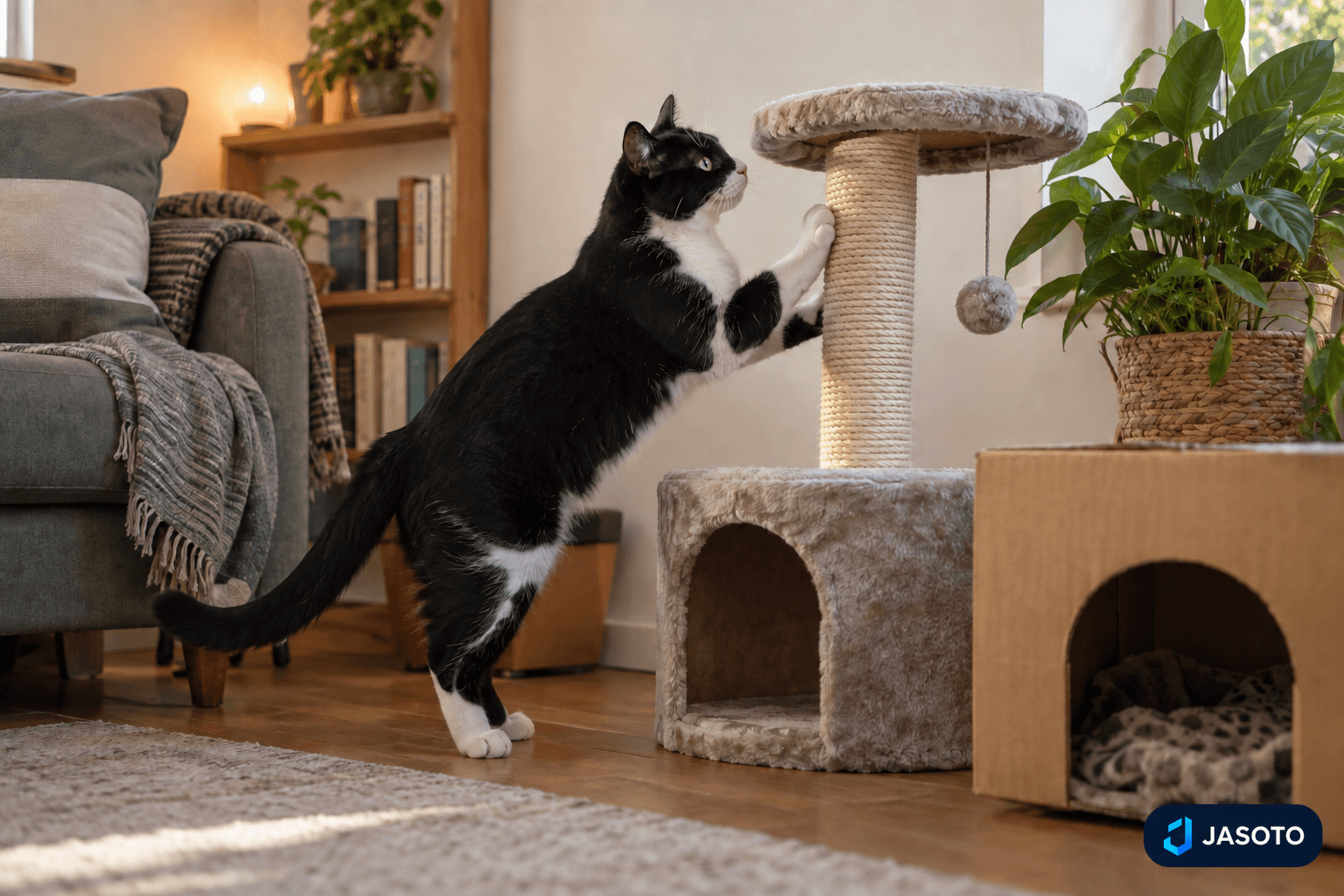
AI-generated illustrative image. It does not depict an actual customer project or a tested product.
An indoor cat play space does not need to dominate a smaller home to be useful. In practice, the best setup is often a modest corner or a small cluster of items that gives the cat somewhere to climb, scratch, hide and interact without turning the room into an obstacle course. The aim is not to fill every spare inch. It is to give your cat a few well-chosen options that fit the way they already behave.
That means starting with observation rather than shopping. Where does the cat like to rest? Which surfaces do they scratch? Do they prefer to watch from above or disappear into a quiet spot? When you work from those clues, you can create a play area that feels natural to the cat and practical for the household. In a smaller home, that balance matters more than size alone.
At a glance
- Start by observing where your cat already rests, watches and scratches.
- A useful indoor play area offers climbing, scratching, hiding and supervised play.
- Stability, placement and suitability matter more than size or appearance.
- Keep toys supervised, rotate a few items and review what the cat actually uses.
1. Begin with the space your cat already chooses
Before buying anything, watch how your cat uses the home. A cat that likes to sit on the back of the sofa, for example, may be telling you that height and observation matter. A cat that scratches beside a doorway may prefer a particular surface or a spot that feels prominent. These habits are useful because they show you where enrichment is most likely to be accepted, rather than ignored.
It is usually more effective to place useful accessories where the cat already spends time than to put everything in the most empty part of the room. A busy passage may look convenient to a person, but it can make a cat feel interrupted. Cats Protection’s guidance on indoor cats is a reminder that indoor cats still need opportunities for natural behaviours, including the ability to choose, retreat and engage on their own terms. That means your first decision is not what to buy, but where the cat can comfortably use it.
2. Build around watching, hiding and retreating
A good indoor cat play area is not only about movement. Many cats want a place to observe activity from a safe position, then disappear when they have had enough. You can support that by offering a stable watching point and a separate hiding place. Those two functions may be close together, but they should not force the cat into the same space all the time. The point is choice.
A hiding place should stay a retreat, not a location where people keep reaching in to start play. If the cat uses a covered bed, an open box or another quiet hide, let it remain undisturbed when the cat is resting there. That helps the space become genuinely useful rather than merely decorative. In a small home, a simple hide in one corner and a clear path away from it can be more valuable than a larger setup that leaves the cat no obvious exit.
3. Choose climbing furniture for stability, not just size
A cat climbing structure should be judged on whether it works in your home, not on how dramatic it looks in a product photo. Check the footprint, height, assembly and any fixing requirements before you decide. A tall piece may look impressive, but if it wobbles or blocks an awkward route through the room, it is unlikely to be used well. Stability matters because a cat will jump with confidence only when the surface feels secure.
It also helps to think about how the cat gets up and down. A useful platform should suit the individual cat and leave a practical route down, rather than forcing an awkward jump to the floor. In a smaller home, the most suitable piece may be a compact climber placed near a wall or a calm corner. The best comparison is not between models of different heights alone, but between how safely and comfortably each one fits into the actual room.
4. Match scratching surfaces to the cat, not the label
Scratching is one of the easiest behaviours to support well, but only if you match the surface to the cat’s preference. Some cats will use a vertical post repeatedly; others are drawn to a flatter surface. Comparing scratching options by orientation and material is more helpful than buying several versions at once. If you already know what the cat tends to use, start there. If you do not, observe first and add more later only if needed.
Placement also matters. A scratching surface should be easy for the cat to reach without obstructing doors or creating a hazard around windows. That may sound like a minor detail, but awkward placement can make a perfectly good item feel inconvenient. In a shared living room, a scratching post beside a resting spot may work better than one squeezed into a corner the cat never approaches. The goal is not to hide the scratcher from view. It is to put it where the cat can use it naturally and often.
5. Use play as a shared activity, not just a pile of toys
Interactive play is more effective when it feels like a sequence the cat can follow: stalk, chase and catch. Rather than waving a toy constantly out of reach, let the cat move towards it, commit to it and have a chance to succeed. That makes the session more engaging and better reflects the kind of behaviour indoor cats need to express. Short, supervised sessions are usually more useful than leaving a toy out and hoping it gets used.
Cats Protection recommends regular play, particularly for indoor cats. The important point is that the play should suit the cat in front of you. A younger or very active cat may want more repeated movement, while a cat with lower mobility may prefer slower action or a toy that moves less sharply. If the cat seems uncomfortable, distracted or ready to leave, stop rather than pushing for more. The session should feel like an invitation, not a demand.
6. Keep supervision and safety part of the routine
When you use wand toys or string toys, supervision is essential. These items are best treated as shared tools for active play and then put away when the session ends. Storing them securely helps prevent unsupervised access and keeps the room tidier at the same time. It also makes play feel like a specific event, which can be useful in a smaller home where you may not want toys spread everywhere.
It is also sensible to inspect toys for loose parts or damage before using them again. A toy that is fraying, splitting or otherwise worn may not be suitable for continued play. This is one of the easiest habits to build into your routine because it takes only a moment and can prevent a disappointing session. If your cat tends to lose interest quickly, keeping the toy in good condition may not be enough on its own, but it removes one common reason for play to fall flat.
7. Rotate a few items instead of crowding the room
A smaller home usually works better with a limited number of accessible items and a few extras stored away. Rotation keeps the environment from becoming visually cluttered while still giving the cat novelty over time. That does not mean you need a large collection. In fact, too many items at once can make it harder to see what the cat actually prefers. A small, deliberate selection is easier to manage and review.
A plain cardboard hide can be useful alongside purchased accessories if it is safe and suitable for your cat. The value of something simple like this is that it adds a different kind of retreat without requiring a large footprint. If a cat uses the cardboard hide, that tells you something useful about preference. If it ignores it, you have learned that the cat may prefer a different shape or position. Rotation and observation work together: you keep the room calm, but you also keep learning.
8. Test the layout in a real room, not in theory
A play space should make sense in the room where it actually lives. For a shared living room, for example, a stable scratching post near an existing resting spot may be more successful than a complicated arrangement in an unused corner. A removable play basket can be stored out of reach when not in use, which helps the room remain practical for people as well as the cat. This sort of setup is useful because it can change with your routine rather than taking over the whole area.
Review how the space is used after about a week. The question is not whether each item looks right, but whether the cat chooses it. Are they climbing, scratching, hiding and returning to the same places, or do they avoid the new setup? If one item is clearly being used and another is ignored, resist the temptation to assume the whole idea has failed. Often the answer is simpler: one piece is in the wrong place, or one type of surface suits the cat better than another.
9. Avoid common mistakes that make a space less useful
One common mistake is buying too much too soon. A pile of toys can create more clutter than enrichment if the cat only uses one or two items. Another is putting every resource in the most open or most convenient place for people, even when that leaves the cat without privacy. A third is choosing a scratcher or climber for appearance first and suitability second. In each case, the human preference for neatness or style can get in the way of the cat’s actual needs.
It is also easy to make a retreat spot too public. If a hiding place becomes a place where people routinely reach in, the cat may stop treating it as safe. Likewise, a climbing piece that is unstable or awkwardly positioned may be treated with caution rather than enthusiasm. These are not dramatic failures; they are small practical issues that quietly reduce use. The advantage of starting small and observing carefully is that you can spot these problems early and correct them without turning the whole room upside down.
10. Use a simple method to decide what to buy next
A practical way to plan an indoor cat play area is to work in three stages: observe, add, then review. First, observe where the cat already rests, watches and scratches. Second, add one or two suitable items that support those behaviours, such as a stable scratching surface, a climbing option or a quiet hide. Third, review what the cat actually uses after a short period and adjust from there. That method keeps the process grounded in behaviour rather than guesswork.
When you are deciding between accessories, ask which gap each item fills. Does the room already offer a place to watch but not a place to scratch? Does the cat have a hide but no safe climbing route? If a product does not solve a clear problem, it may be unnecessary. This approach helps you avoid filling a small home with mismatched pieces and instead build a space that is calm, varied and genuinely useful for the cat.
Your practical checklist
- Provide choices for hiding, scratching and watching.
- Check the stability, height and access of climbing furniture.
- Match scratching surfaces to the cat’s preferred orientation.
- Supervise wand and string toys, then store them securely.
- Inspect toys for loose parts or damage before use.
- Keep retreat areas quiet, comfortable and undisturbed.
- Review which items are used after a week and adjust the layout if needed.
Frequently asked questions
Does an indoor cat play area need to be large to be effective?
Not necessarily. A smaller corner can work well if it supports the cat’s natural behaviours and is placed thoughtfully. Stability, access and comfort matter more than the amount of floor space alone.
Should I buy a cat tree before I know what my cat likes?
It is usually better to observe first. Watch where your cat already rests, watches and scratches, then choose a climbing or scratching option that matches those habits and fits the room safely.
How can I tell if a hide is being used properly?
A hide works best when the cat can retreat there without being disturbed. If the cat uses it to rest or withdraw, that suggests it is serving its purpose. If people keep reaching in, it may stop feeling like a real retreat.
Is it better to leave toys out all the time?
Not always. A small selection can be kept accessible, but supervised toys such as wand or string toys are best stored away after use. Rotation can help maintain interest without filling the room with clutter.
Explore Daily Living UK
Use the guide to compare suitable products. Check the current specifications, availability, delivery and price on Daily Living UK before ordering.
Browse Daily Living UK