
Daily Living UK · UK Guide 2026
Washable Dog Bed Buying Guide
Updated 9 September 2026 · 2,212 words
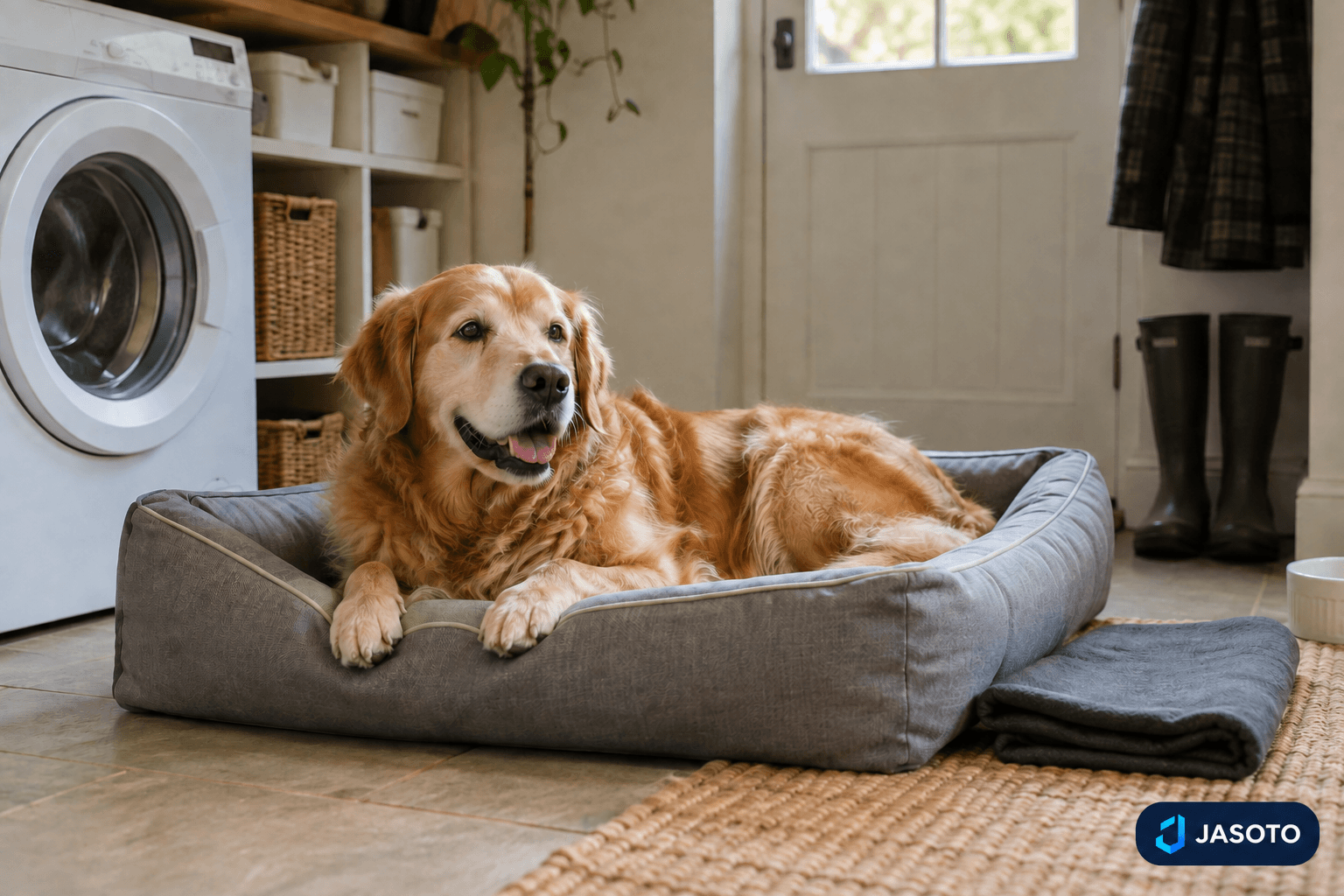
AI-generated illustrative image. It does not depict an actual customer project or a tested product.
A washable dog bed sounds straightforward until you start comparing labels, sizes and care instructions. In practice, the best choice is usually the one that fits your dog’s sleeping habit and your own routine for cleaning, drying and putting the bed back together. If a bed looks attractive but cannot be washed in a way that works for your home, it may end up being less useful than a plainer option that is easier to maintain.
The most sensible way to compare washable dog beds is to begin with usable sleeping space, then move through care instructions, drying time, floor grip and the position in which your dog usually rests. That order matters because the outside shape can be misleading, and “washable” can mean several different things. A removable cover, a whole-bed wash or a gentle hand wash are not the same thing, so the label needs to be read carefully before you decide.
At a glance
- Compare the internal sleeping area first, because outside dimensions can be misleading.
- Read the washing label closely so you know whether the cover, filling or whole bed can be washed.
- Think about drying time and where the dog will sleep while the bed is being cleaned.
- Check floor grip, seam condition and access height as part of everyday practicality.
Start with how your dog actually sleeps
Before comparing styles, watch how your dog settles down on a typical day. Some dogs curl tightly and are happy in a compact sleeping area, while others stretch out and need much more length. If you measure only the outside of the bed, you can miss the space your dog really has to lie in. The most useful comparison is the internal sleeping area, because that is where your dog will actually rest.
It also helps to think about the entrance or step-in height, not just the overall footprint. A bed can look generously sized yet still be awkward to climb into if the sides are high or the opening is narrow. That matters especially for dogs that prefer easy access. If movement is difficult, the right answer should come from individual assessment rather than from a product description alone, so it is sensible to ask your vet about comfort or mobility concerns.
Measure the usable sleeping space, not the frame
A washable dog bed may have thick bolsters, raised edges or a deep rim that take up room inside the bed. Those features can be useful for some dogs, but they also reduce the area available for sleeping. This is why the outside measurement is not enough on its own. Compare the bed’s internal dimensions with the space your dog occupies when resting comfortably, and do not assume a larger-looking bed is automatically a better fit.
A practical approach is to picture your dog in the positions you see most often. For a curled sleeper, the usable area needs to support a rounded shape without forcing the body against the sides. For a stretched-out sleeper, length matters more than decorative shape. If you are undecided between two sizes, the one with the clearer usable sleeping space is usually the easier specification to judge, because it tells you more about comfort than the outer trim or styling.
Read what washable really means on the label
The word washable is not a single promise. It may apply only to the cover, to the whole bed, or to a part that can be hand washed gently. That is why you need to read the care instructions in detail rather than relying on the headline description. Look for the washing temperature, the cycle type, the drying method and whether the base can be washed at all. Those details determine whether the bed suits your laundry routine.
It is also important to check whether the instructions match the facilities you actually have. A bed might be washable in theory but awkward in practice if the filling is too large for your machine or if you do not have a suitable way to dry it completely. A removable cover can be helpful, but only if it comes off without a struggle and fits back on again properly. If that part looks fiddly, the bed may be more troublesome than the label suggests.
Think through drying time before you buy
Drying is often the overlooked part of owning a washable dog bed. If a bed must be cleaned regularly, you need a plan for the period when it is wet, not just for the wash itself. In a practical household, that means asking whether you can dry the cover or filling completely and how long it will take before the bed can be used again. A bed that is technically washable may still be inconvenient if it is difficult to dry within your normal routine.
It can help to imagine a muddy-day scenario. The dog comes in dirty, the bed needs a wash, and you still need somewhere comfortable for the dog to rest while the bedding is drying. That is where a spare suitable bed or blanket can be useful. Planning for this in advance is better than discovering that the only sleeping option is unavailable for longer than expected. The point is not to choose the quickest product at any cost, but to avoid a design that creates avoidable hassle every time it is cleaned.
Compare cover design and replacement options
When a bed has a removable cover, the practical question is not only whether it can be taken off, but whether it can be replaced without difficulty. Fastenings should be checked before you buy, because awkward closures can turn a useful washing feature into an irritating chore. If the cover is difficult to refit, cleaning may become a task you postpone, which defeats the point of choosing a washable bed in the first place.
Replacement covers are worth considering for the same reason. If one cover is drying, a spare can help keep the sleeping area available. That is not essential for everyone, but it is a useful comparison point if your dog uses the bed daily. The benefit is greatest when the cover and the bed structure are easy to separate and reassemble. A bed that is simple to maintain is often the one that gets cleaned properly, rather than the one with the most appealing description.
Choose a resting place that supports calm
Dogs Trust highlights the value of a clean, dry and comfortable place to rest. That makes the location of the bed part of the buying decision, not just an afterthought. A good bed is easier to use if it sits in a quiet position where the dog can move away from household activity. If the bed is placed where people repeatedly disturb the dog, the dog may not settle well no matter how washable the bed is.
You should also check the base against the floor surface in your home. Some beds shift more than others, and a sliding base can make the bed feel less secure. In addition, think about how easily the fabric picks up dirt. A washable cover is helpful, but if the surface traps dirt in a way that is hard to remove, you may spend more time cleaning than you expected. The best resting spot is usually one that combines comfort, low disturbance and a practical surface underfoot.
Look at grip, wear and everyday durability
Floor grip matters because a bed that skids around is less settled and may be annoying for the dog to step into or turn around on. When comparing products, look at how the base behaves on your floor rather than assuming all beds will stay put. This is especially relevant if the bed will sit on a smooth indoor surface. A stable bed is generally easier for a dog to trust, because it feels predictable when they move onto it or change position.
Durability should be judged with ordinary wear in mind, not with the assumption that any fabric bed will survive everything. Worn seams and damaged filling are things to watch for, particularly if your dog chews bedding. No ordinary fabric bed should be treated as indestructible. If you are comparing options, look for signs that the bed is constructed well enough for the way your dog uses it, and keep an eye on how it holds up once it is in regular use.
Be cautious with comfort claims
Descriptions such as calming or orthopaedic can sound reassuring, but they are not proof that a bed will solve a health or behaviour problem. A washable dog bed should be chosen on the basis of its documented specifications and your own observation of your dog’s comfort. That keeps the decision grounded in what you can actually compare: size, care, drying, access and stability. It also avoids over-reading labels that may describe style or general design rather than a specific benefit in your household.
If there are concerns about mobility, pain, or any other individual issue, the right next step is professional advice rather than a product label. The same applies if you are unsure whether a certain bed height or structure suits your dog’s needs. A bed can support comfort, but it should not be treated as a stand-in for an assessment where one is needed. This approach keeps the buying decision realistic and avoids building expectations around wording that is too vague to be useful.
Use a simple ownership routine to judge practicality
A useful way to compare beds is to walk through the full cleaning routine from start to finish. On a muddy day, you would remove loose dirt as appropriate, follow the washing instructions, dry the parts completely and rebuild the bed before your dog uses it again. If any step in that process feels awkward, expensive in time or difficult to repeat, the bed may not be a good match for your home, even if it looks ideal on paper.
This same routine helps you separate genuine convenience from marketing language. A bed is practical when the cleaning process fits your life, not when it simply sounds easy. For one household, a washable cover may be enough. For another, the filling, access to drying space and the ability to refit the cover matter more. Comparing products with a real routine in mind often exposes the difference between something that is technically manageable and something that is genuinely easy to live with.
Make the final comparison from the dog’s point of view
Once you have checked size, washability, drying and stability, return to the dog’s sleeping position. That final check prevents you from being distracted by colours, stitching or decorative shape. A beautiful bed is less useful if it does not provide usable sleeping space or if the care process is too cumbersome to keep up. The aim is to choose a bed that fits both the dog and the home, not one that looks like the best option only in a product image.
If two beds seem similar, the better one is usually the one with clearer care instructions, easier removal and refitting of the cover, more suitable internal space and a more secure base on your floor. Those are the features that affect day-to-day comfort and maintenance. Keeping the decision anchored to those points makes the buying process much simpler and helps you avoid paying for a design that seems attractive but is less convenient once it is in regular use.
Your practical checklist
- Compare the bed’s internal sleeping dimensions with your dog’s usual sleeping position.
- Check whether washable applies to the cover, the filling or the whole bed.
- Read the washing temperature, cycle and drying instructions carefully.
- Confirm the bed can be removed, refitted and dried in a way that suits your home.
- Look at the base for grip on your floor and consider the entrance height.
- Plan a spare resting place for the period when the bed is washing or drying.
- Watch for worn seams or damaged filling if your dog chews bedding.
Frequently asked questions
Can every washable dog bed go in a machine?
No. The label may apply only to a removable cover, or it may specify hand washing for part of the bed. Always follow the exact care instructions and check that your machine can take the item.
Is a larger bed always the safer choice?
Not necessarily. What matters most is usable sleeping space and easy access. A bed can be larger on the outside yet offer less useful room inside because of thick sides or raised edges.
What should I do if the bed takes too long to dry?
Plan for a spare bed or blanket so your dog still has a comfortable resting place. If drying is consistently awkward, a simpler design may be a better fit for your routine.
Should I rely on terms like calming or orthopaedic?
Use them cautiously. Those words do not prove that a bed will solve a health or behaviour problem. Compare the documented specifications and seek individual advice if you have concerns about comfort or mobility.
Explore Daily Living UK
Use the guide to compare suitable products. Check the current specifications, availability, delivery and price on Daily Living UK before ordering.
Browse Daily Living UK