
Daily Living UK · UK Guide 2026
Shoe Storage for Small Hallways
Updated 9 September 2026 · 2,351 words
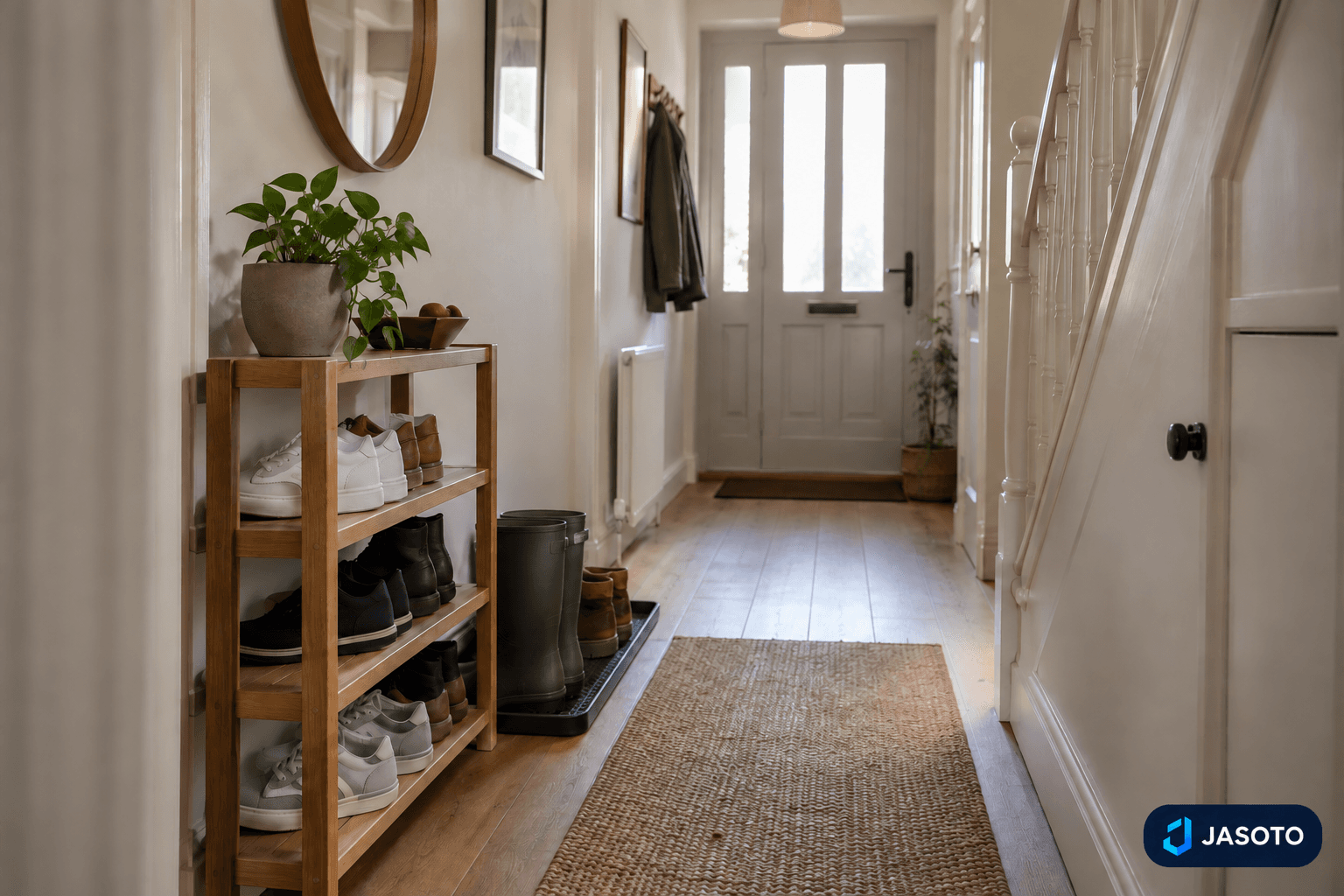
AI-generated illustrative image. It does not depict an actual customer project or a tested product.
Good shoe storage should make leaving the house easier, not add one more obstacle at the front door. In a small hallway, that usually means two things at once: keeping a clear route through the room and giving the shoes you actually use a reliable place to go. If the hallway feels tight, the best solution is rarely the biggest unit or the neatest-looking one. It is the one that fits your walking space, works with the door swing and matches the way your household comes and goes.
That is why it helps to start with the shoes rather than the furniture. A hallway storage choice that looks sensible in a showroom can become awkward once you add everyday trainers, school shoes, work shoes, boots and the occasional pair that only comes out sometimes. A practical approach is to measure the room, count the pairs in use, and then choose a storage style that protects access as much as it stores footwear.
At a glance
- Start with the shoes you use every week, not the full collection.
- Check walking space, door swing and access to nearby fixtures before choosing furniture.
- Match the storage style to the routine your household can keep up.
- Separate wet footwear from dry storage so the main unit stays usable.
Start with the pairs you use, not the pairs you own
The first useful step is to sort shoes into daily use, occasional use and another season. That sounds simple, but it changes the whole decision. In a small hallway, the aim is not to store every pair at the front door. It is to keep the everyday group within easy reach and move the rest elsewhere if space is limited. If the household has a number of shoes that appear and disappear through the week, the hallway should only need to absorb the footwear that is genuinely part of the daily routine.
It also helps to count the pairs currently landing in the hallway over the course of a week. That gives a truer picture than trying to guess how many the unit should hold. A family might think they need space for everything, when in practice only a few pairs are used at the same time. The shoes that stay in the hallway every day are the ones that should shape the layout. Once those are covered, you can decide whether the rest need a separate storage place elsewhere in the home.
Check capacity with boots and larger shoes in mind
Capacity claims can be misleading if they are treated as a promise rather than a rough guide. A unit described as holding a certain number of pairs may assume smaller footwear. That matters in a hallway where boots, wider shoes or bulkier styles are part of the household mix. If you have ankle boots or other larger pairs, it is worth counting them individually rather than assuming they will fit in the same way as lighter footwear.
Internal measurements matter as much as the overall size of the furniture. A compact cabinet may look suitable on paper, but a shelf that cannot take the height of a boot, or a compartment that is too shallow for the shoe length, will quickly become frustrating. This is one of the most common mistakes in a tight hallway: choosing by appearance alone. When comparing options, check whether shelves are fixed or adjustable, and think about whether the largest shoes need a dedicated place rather than being forced into a generic slot.
Protect the walking route through the hallway
In a small hallway, storage should never make the route harder to use. A useful way to test this is to mark the proposed footprint on the floor with removable tape. That gives a realistic sense of how much space the unit will take up before anything is bought or moved in. Once the outline is marked, open the nearby doors and walk past while carrying something such as shopping, because a hallway often feels fine when empty but awkward in real use.
This check should include anything the furniture might obstruct: radiators, sockets, meters and cupboards behind it. Those details are easy to overlook when a unit looks slim enough to fit. It is also worth remembering that a shallow cabinet can still need a surprising amount of space in front of it when the door or drawer opens. The hallway may technically have enough width for the cabinet itself while still being too tight for comfortable passage. The safest rule is to keep the walking route clear first and let the storage fit around it, not the other way round.
Open, closed and boxed storage all solve different problems
The design you choose should reflect how the household behaves. Open racks make shoes easy to spot and easy to put away, which can be helpful when people want a low-friction routine. If everyone in the home is more likely to drop shoes on a visible shelf than to open a door, then a rack may keep the system working simply because it is quick to use. The trade-off is that everything remains on display, so the hallway can look busier even when it is technically organised.
Closed cabinets hide visual clutter, which can make a small hallway feel calmer. The downside is that they rely on everyone using the door or drawer correctly. In real households, that extra step can be the point at which shoes start returning to the floor instead of the cabinet. Clear boxes offer a different compromise. They can separate occasional pairs and make them easier to identify, but they add handling, because a stack of boxes introduces an extra step each morning. When comparing these options, the best choice is usually the one your household will actually maintain, not the one that looks tidiest in theory.
Make sure the furniture suits the day-to-day routine
Hallway storage works best when it makes ordinary habits simpler. If more than one person uses the entrance, it can help to give each person an easy-to-reach shelf or section. That reduces the chance of everyone using the same spot and creating a pile. A small space for guests can also help, because visitor shoes need somewhere obvious to go without displacing the household’s own pairs.
It is also wise to move out-of-season pairs regularly. If summer shoes are still taking up the prime space once colder footwear becomes the priority, the unit will feel smaller than it really is. Sometimes the issue is not capacity but poor rotation. A useful test is to look at what is in the hallway now and ask whether each pair genuinely needs to be there today. If not, it may belong in a different storage location until it is needed again. That simple filter often solves more overcrowding than buying a larger unit.
Choose a finish and structure that are easy to live with
In a hallway, the surface of the furniture matters because it is likely to be touched often and marked easily. A finish that can be wiped clean is more practical than one that looks good only when untouched. That is especially relevant near the front door, where shoes, bags and passing hands can leave the unit looking tired if it is difficult to maintain. The goal is not to find something fragile-free, but to choose a finish that fits the reality of an entrance space.
If the furniture comes with anchoring instructions, follow them. Stability matters whenever a unit is narrow, tall or likely to be used every day. This is not about adding unnecessary complication; it is about making sure the storage remains a dependable part of the hallway rather than something that shifts, wobbles or becomes awkward to use. Because hallway storage is often placed in a tight position, the practical details of how it stands and how it is secured are as important as the style of the doors or shelves.
Separate wet footwear from dry storage
Wet shoes need their own approach. It is better to use a separate washable mat or tray for damp footwear than to enclose them immediately in a cabinet. That gives the shoes a chance to dry before they are stored, which is a more sensible routine than sealing in moisture at the door. A hallway shoe system that ignores this step may look neat for a day but become inconvenient very quickly.
This is one of the clearest examples of how small routines affect storage success. If the household regularly comes in from rain, mud or outdoor walks, there needs to be a place where wet footwear can sit without causing trouble. A tray or mat is not a glamorous solution, but it prevents the main storage from being used for the wrong job. Once the shoes are dry, they can move into the cabinet, rack or box system that suits the rest of the week.
Use the hallway’s real constraints to narrow the choice
Every hallway has its own limits, and the right shoe storage should respect them. A corridor that is narrow but long may take a slim cabinet more easily than a wide bench. A space with a busy door swing may need a shallower design, even if that means storing fewer pairs in one place. In some homes, a bench can be useful because it gives people somewhere to sit while putting shoes on, but only if there is enough room for one person to sit without blocking everyone else. The bench idea sounds convenient until it competes with the route people need to use every day.
For that reason, comparison should be based on three simple questions: can people still walk through comfortably, can the unit cope with the largest shoes, and can the household keep the routine going without extra fuss? If the answer to any of those is no, the design is probably too ambitious for the space. This is where a clear floor plan, even a rough one marked with tape, is more useful than any product description because it shows how the hallway will work in practice.
Troubleshoot the common reasons hallway shoe storage fails
If shoes keep ending up beside the unit, the problem may be access rather than storage capacity. People are often quick to blame the furniture when the real issue is that opening the door, bending down or finding the right pair takes too much effort. In that case, a simpler, more direct arrangement can work better than a larger one with awkward compartments. The easiest system is often the one that reduces the number of steps between taking shoes off and putting them away.
Another common problem is overfilling the space with too many categories at once. When daily shoes, occasional shoes, guest pairs and out-of-season footwear all compete for the same frontage, the hallway becomes cluttered even if the total number of pairs has not changed. The answer is usually to split the load: keep the everyday pairs closest to hand, move the rarely used shoes elsewhere, and let the hallway do one job well. If the furniture still feels strained after that, revisit the measurements rather than assuming the storage style itself has failed.
A simple method for choosing the right option
A practical selection method can keep the decision steady. First, count the daily pairs and note the largest shoes, including boots. Second, mark out the intended footprint on the floor with removable tape and test the door swing and walking route. Third, decide whether the household needs an open rack, closed cabinet or box-based setup, based on how people actually put shoes away. Fourth, add a wet-shoe solution such as a mat or tray so damp footwear does not go straight into enclosed storage. Finally, check whether everyone can use the system without extra effort. If any step feels awkward, that is a sign to revise the layout before buying.
This approach is useful because it keeps the decision grounded in the hallway itself. It also avoids a very common trap: choosing furniture for a neat mental picture rather than for the real, everyday route between the front door, the cupboard, the stairs and the rest of the home. In a small hallway, shoe storage succeeds when it disappears into the routine. You should notice it because it works, not because it demands attention every time someone leaves the house.
Your practical checklist
- Count daily pairs separately from occasional and out-of-season shoes.
- Measure the largest footwear, including boots, against internal space.
- Mark the footprint on the floor and test doors opening nearby.
- Keep a clear walking route to radiators, sockets, meters and cupboards.
- Provide a tray or mat for wet footwear before it goes into storage.
- Follow any anchoring or stability instructions for the furniture.
Frequently asked questions
What is the safest first measurement to take for hallway shoe storage?
Start with the walking route, then check the furniture footprint against the space left for doors and passage. That shows whether the unit will genuinely fit the hallway, not just the wall.
Should I choose a shoe rack if I want the hallway to look tidier?
A closed cabinet usually hides shoes better, but a rack is easier to use quickly. The better option is the one the household will put away consistently without blocking the hall.
How can I decide whether a bench is practical in a small hallway?
Only choose a bench if there is enough room for someone to sit without stopping other people passing through. If the sitting area blocks the route, a slimmer storage option is likely more suitable.
What should I do with shoes that are not used every day?
Keep the everyday pairs in the hallway and move occasional or out-of-season footwear elsewhere if space is tight. That keeps the front door area focused on the shoes you actually need there.
Explore Daily Living UK
Use the guide to compare suitable products. Check the current specifications, availability, delivery and price on Daily Living UK before ordering.
Browse Daily Living UK