
Daily Living UK · UK Guide 2026
Under-Sink Storage Ideas
Updated 9 September 2026 · 2,320 words
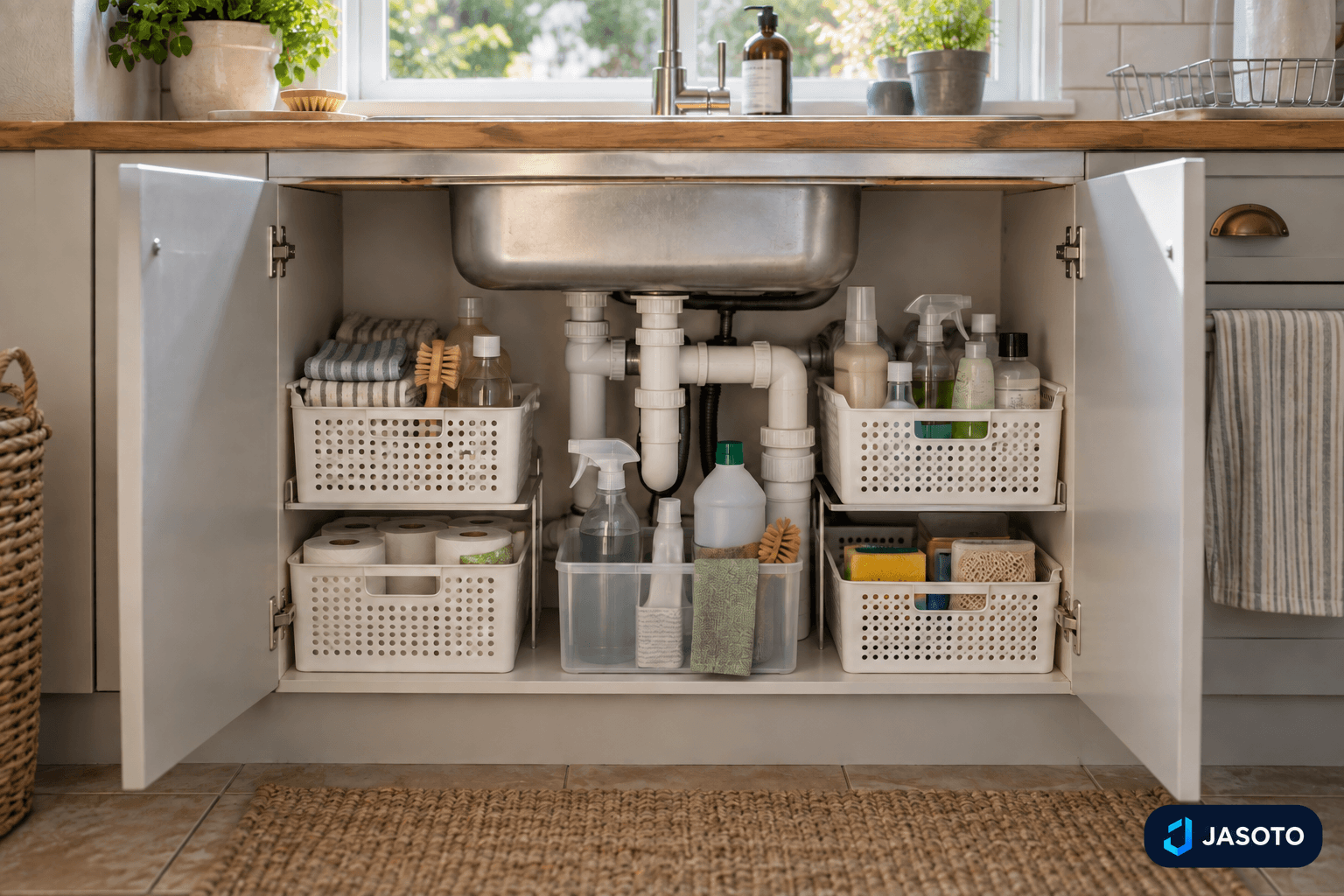
AI-generated illustrative image. It does not depict an actual customer project or a tested product.
An under-sink cupboard looks simple until you start using it. The pipes, stop tap, hinges and door opening all take part of the space, so a product that seems neat on a screen can become awkward in the cabinet. The most useful under-sink storage ideas begin with the cupboard itself, not with a particular organiser. If you measure what you can truly reach and what must stay clear, the rest of the decision becomes much easier.
That approach also helps you avoid buying a system that only works when the cupboard is empty. Under-sink storage has to fit around plumbing, hold items you use often and remain easy to reset after cleaning. A practical layout is usually more valuable than a complicated one, especially in a small kitchen where every centimetre needs a job.
At a glance
- Measure the actual usable space, not just the cupboard’s outer size.
- Choose organisers by access and plumbing clearance, not by appearance alone.
- Keep everyday items at the front and refills at the back.
- Test the layout before buying extra storage or filling every gap.
Start with the usable space, not the advertised size
The first step is to empty the cupboard and measure the internal width, depth and height. Do not rely on the outside dimensions of the cabinet or on the dimensions printed for an organiser. Those numbers rarely account for the parts that make under-sink storage difficult: the hinges, the pipes, the curved shape of the trap and the way the door opens into the space.
It also helps to measure the tallest bottle you want to keep there, including its trigger handle. A cleaning spray that stands up easily in a shop basket can become a problem once the trigger adds height. If the bottle needs to be angled or laid down to fit, that affects how quickly you can grab it and whether it will spill. Thinking through the tallest item first stops you designing around a storage unit that suits only smaller products.
Map the obstacles before you choose any organiser
Under-sink cupboards are awkward because they are interrupted by fixed features. Pipes and joints take away more usable room than they first appear to, and the stop tap must stay accessible. A good layout respects these obstacles rather than trying to hide them. If a storage item blocks access to a pipe connection or makes it hard to reach the tap quickly, it is not a helpful arrangement, however tidy it looks.
A simple way to test the shape is to cut a cardboard footprint the same size as a possible organiser and slide it into position. This is more informative than guessing from a photograph. You can see whether the cardboard touches the door, catches the hinge or leaves a useful channel around the plumbing. It is also worth opening the door fully and practising lifting your tallest item out. If the movement feels awkward when the cupboard is empty, it will become more difficult once the space is full.
Compare baskets, shelves and drawers by how you will use them
Different organisers solve different problems, so the best choice depends on what you want the cupboard to do. A handled caddy is useful when products need to travel around the home. If your cleaning spray, cloths and sponge all move from the kitchen to the bathroom or utility area, a caddy makes it easier to carry them together without making several trips.
Separate baskets are better when you want to sort items into clear groups. One basket might hold cloths, another washing-up supplies and another replacement sponges. That setup works well if you prefer to see everything at a glance and avoid overfilling one container. A raised shelf can be a good use of vertical space, but only if it clears the plumbing and suits the load you plan to put on it. A light shelf may work for cloths and small bottles, while heavier items need more careful thought.
A sliding drawer is often attractive because it brings items forward instead of forcing you to reach into the back of the cupboard. However, it needs enough room to pull past the door and hinges, and its loaded dimensions matter as much as the empty frame. Fixing requirements matter too. In a rented home, a removable system can be easier to use than a solution that needs to be screwed into the cabinet. The right comparison is not which organiser looks neatest, but which one fits your cabinet, your routine and your level of access.
Use the front of the cupboard for the things you reach most often
Once you choose a format, decide what belongs in the easiest position. The items you use every day should go at the front so they can be taken out quickly without moving half the cupboard. Duplicates and backups are usually better at the back, where they do not interrupt your routine. This simple front-and-back rule prevents a common storage mistake: letting spare stock take over the space meant for the things you actually use.
A small example makes the point clear. If you keep washing-up liquid, a cloth and a sponge in one front caddy, you can complete a basic clean-up without searching. Refill bottles, spare gloves or extra cloths can stay behind them in a basket or on a back shelf. That arrangement is often more efficient than placing all cleaning items together in one deep container, because you do not have to lift everything out to reach the most useful item. The aim is not to make the cupboard look full of matching containers; it is to make the daily task quicker and less frustrating.
Leave plumbing and connections accessible at all times
Under-sink storage should never make the cupboard harder to inspect or maintain. The stop tap, plumbing joints and any appliance connections need to remain accessible, even when the cupboard is organised. If an item has to be removed every time you need a look at the pipes, the storage has taken over a function it should not have. This is especially important where the cupboard may need attention from another person later, because the layout should support easy access rather than create another obstacle.
It is also worth remembering that the cupboard is not just a storage zone but part of the kitchen infrastructure. Products should not be packed so tightly that you cannot quickly see if something has dripped, shifted or dampened the base. A useful storage arrangement still leaves room to reach around the fixed parts. That is why a smaller system can be better than a larger one: the smaller one may allow the cabinet to keep doing its main job while giving your cleaning products a tidy home.
Keep products in safe, labelled containers
Cleaning products should stay in their original labelled containers and be stored according to their instructions. That matters for clarity as much as for order. A cupboard may look calmer when bottles are transferred into matching decants, but an original label tells you exactly what the product is and how it should be handled. It also helps reduce confusion when several similar bottles are stored together.
An ordinary basket is not child-resistant storage, so the cupboard layout needs to reflect who can reach it. Where children or pets can access the area, choose a suitable secure arrangement for the products involved. The practical point is not to make the cupboard overcomplicated; it is to avoid assuming that any tidy container is automatically a suitable storage solution. A neat arrangement still needs to match the products, the household and the instructions on the item itself.
Make the cupboard easy to reset after cleaning
A good under-sink layout should survive routine use, not just look neat on the day you set it up. If the system takes too long to put back together, it will drift out of order. That is why simplicity is often an advantage. One basket for daily cleaning items and one for refills is easier to maintain than a multi-level arrangement that creates several small places for things to end up.
Think about the reset process as part of the design. Can you wipe the base quickly? Can you lift one container out without emptying three others first? Can wet cloths dry appropriately, or are they trapped in a space where they stay damp? These questions matter because the cupboard is a working area. If the layout makes cleaning harder, it will not stay useful for long. A manageable system is usually one you can restore in a minute or two after a weekly tidy, rather than one that demands constant rearranging.
Test the layout before you fill every gap
It is sensible to use the new arrangement for a week before adding more storage. That trial period shows whether the cupboard is easy to live with in ordinary use. You may discover that a caddy works well in the morning but becomes fiddly when your hands are wet, or that a shelf leaves just enough space for bottles but not enough to see what is behind them. These are the kinds of problems that do not show up in a product photo.
During the trial, pay attention to small frustrations. Do you have to move five bottles to reach a cloth? Does a basket block the sink trap? Can you remove the daily items without disturbing the refills? If the answer to any of these is no, the layout needs adjusting. It is better to learn this before the cupboard is full of extra organisers. The best under-sink storage is usually the smallest system that solves the access problem, not the largest system that fills the cupboard.
Troubleshoot common under-sink storage problems
If the cupboard still feels awkward after you have measured and sorted, the issue is often not lack of storage but poor placement. One common problem is overfilling the front section with products that are used only occasionally. That pushes the daily items backwards and makes the cupboard feel more cluttered than it needs to be. Moving duplicates or backups to a rear basket can immediately improve access.
Another issue is choosing a system that looks good when empty but becomes difficult once products are added. A shelf, for example, might fit comfortably until the tallest bottle is placed on it. Likewise, a drawer might work on paper but lose space to the door opening or hinges. If this happens, step back to the cardboard test and re-check the usable footprint. Sometimes the answer is not a different style of organiser, but a simpler one. A single caddy and a separate back basket can outperform a more ambitious unit because each part has a clear role.
Moisture can also cause trouble. If the cupboard base feels damp or items do not dry properly, do not simply cover the problem with a liner and move on. Wipe the cupboard and investigate the moisture rather than hiding it. Storage should make the space easier to maintain, not disguise an issue that still needs attention.
Build a simple layout you can actually keep
A practical under-sink layout often follows a straightforward pattern. Keep the everyday cleaning kit at the front, place refills behind it and leave the pipework clear. Group similar items together so that cloths are not mixed with loose sponges and bottle tops. This makes the cupboard quicker to understand at a glance and easier to put back after use. If every item has a predictable position, you spend less time searching and less time tidying.
The easiest layouts usually rely on clear categories rather than lots of compartments. One front caddy for the products used most often, one basket for backups and perhaps a shelf only where the plumbing allows it. That may sound plain, but it is often exactly what a busy cupboard needs. Fancy storage is not the goal; a cupboard that opens fully, keeps the plumbing clear and allows you to lift out the right item without a struggle is the real success. Once that is in place, the under-sink area stops being an awkward catch-all and becomes a small, dependable part of the kitchen routine.
Your practical checklist
- Empty the cupboard and measure width, depth and height.
- Record the position of hinges, pipes and the stop tap.
- Check the tallest bottle, including its trigger handle.
- Use cardboard to test the organiser footprint in the cupboard.
- Make sure the door opens fully and items can be lifted out easily.
- Keep plumbing, joints and appliance connections accessible.
- Separate daily cleaning items from spare refills.
Frequently asked questions
Are expandable shelves always the best choice for under-sink cupboards?
No. They can work around some pipe layouts, but a simple removable basket may be easier to lift out and clean. The useful comparison is the space you can really use, not the organiser’s advertised width.
Should I buy matching containers before I sort the cupboard?
It is better to sort and measure first. Matching containers only help if they hold the items you need and still let you reach them comfortably around the plumbing and door opening.
What if a storage unit fits when the cupboard is empty but not when bottles are inside?
That usually means the system is too tight for day-to-day use. Re-check the height of the tallest bottle, then try a simpler layout or a smaller organiser that leaves easier access.
How do I keep the cupboard tidy without overcomplicating it?
Use clear categories and a small number of containers. A front caddy for daily products and a rear basket for refills is often easier to maintain than a multi-tier unit with too many separate sections.
Explore Daily Living UK
Use the guide to compare suitable products. Check the current specifications, availability, delivery and price on Daily Living UK before ordering.
Browse Daily Living UK