
Daily Living UK · UK Guide 2026
Small Balcony Furniture Guide
Updated 9 September 2026 · 2,512 words
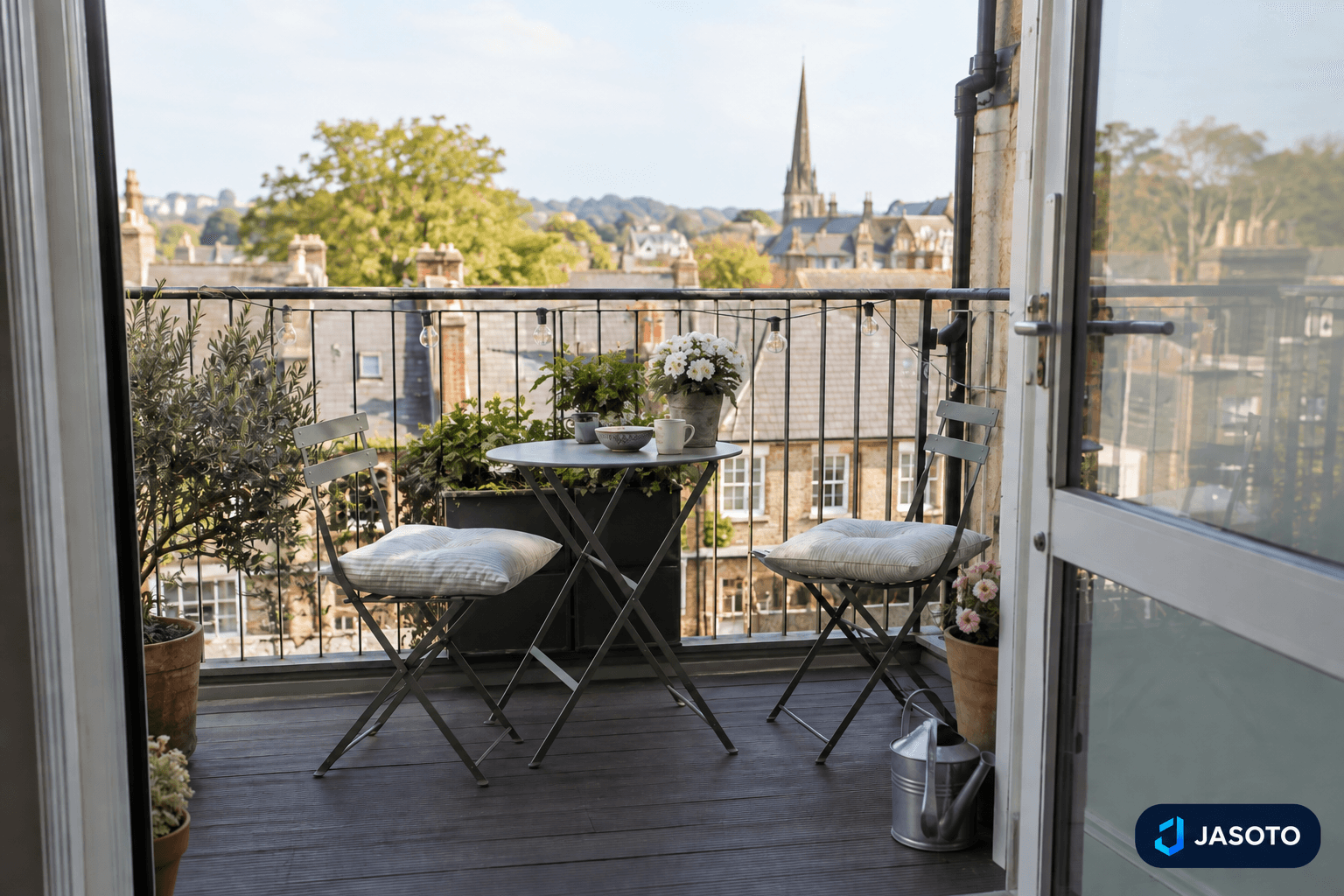
AI-generated illustrative image. It does not depict an actual customer project or a tested product.
A small balcony can become one of the most useful parts of a home, but only if the furniture matches the space rather than fighting it. Before you buy anything, decide what the balcony is actually for and how much room you need to move, sit down, stand up and open the door comfortably. That simple shift in thinking prevents the common mistake of treating a compact balcony like a miniature patio and trying to fit in too many pieces at once.
The best small balcony furniture is not always the smallest furniture. A chair that looks neat in a product photo may feel awkward if there is no room to pull it out, turn it or place your feet properly. A table that seems compact can still block the route to the door. Careful measuring, a clear purpose and a staged layout will usually give you a better result than buying several matching items and hoping they fit together.
At a glance
- Choose one main use for the balcony before comparing furniture.
- Measure the full space, including the door swing, chair pull-back and route indoors.
- Check building rules and product instructions before ordering or fixing anything.
- Start with the main seat and table, then add only what improves everyday use.
1. Start with one clear use for the balcony
The easiest way to plan a small balcony is to decide what you want it to do most often. Some balconies need to work as a breakfast corner. Others are better as a quiet place to read, have a drink or keep a few plants. Once you choose one main use, it becomes much easier to judge what furniture is essential and what is simply taking up space.
A dining setup has different needs from a reading corner. If you want to eat outside, the table height needs to suit the chair and there has to be room for knees underneath. If you want to sit with a book or cup of tea, one comfortable chair and a small side table may be all you need. Trying to combine too many functions often leads to compromises that make none of them feel comfortable.
It also helps to be realistic about how many people will use the balcony on a regular basis. If it is mainly for one person, the layout should support that person first. Occasional guests can often be managed with folding seating kept indoors rather than permanent extra chairs crowding the floor. That approach gives you flexibility without forcing the balcony to carry a full set of furniture every day.
2. Measure the space you actually have
Before looking at products, measure the balcony itself. Record the width and depth, then note the threshold and the way the door swings. These details matter because a balcony is not only a flat floor area; it also needs to remain usable when you open the door and move between indoors and outdoors. A piece that fits the open floor space on paper may still be awkward if it sits in the path of the door or reduces access to the entrance.
When measuring furniture, think about use rather than just footprint. A chair does not stay neatly tucked in all the time. Allow for it being pulled backwards, and check there is still a practical route to the door afterwards. This is one of the easiest things to miss when shopping online, because folded dimensions alone can make an item look more suitable than it really is.
A top-down sketch can help here. Draw the balcony to scale on paper, then mark the intended furniture footprint. If that is difficult, use tape on the floor or a temporary outline on a real balcony to test the arrangement. Seeing the space in full size is often more revealing than reading measurements on a product page, especially when the balcony is narrow or unusually shaped.
3. Check rules before you buy anything fixed or bulky
Balcony furniture decisions are not only about comfort and fit. It is sensible to read your building or tenancy rules before adding furniture, fixings or planters. Some balconies have rules about what can be attached, where items can sit or how much weight is appropriate for the space. If there is any uncertainty, ask the building manager rather than guessing.
That matters because you should not estimate a balcony load limit from its appearance. A balcony that looks sturdy does not automatically mean it can take whatever you want to place on it. If the rules are unclear, the safest approach is to seek clarification from the appropriate person rather than making assumptions. This is especially important before choosing heavy items or anything that would be difficult to move once installed.
It is also worth checking whether your chosen items require any fixing at all. Some compact pieces are simple to place and remove, while others may involve attachments or supports. A small balcony often works best when the furniture is easy to manage and does not create unnecessary complications. That is especially true when the layout may need to change later.
4. Compare folding furniture with stackable furniture
Folding furniture is popular for compact balconies because it can give you flexibility. A folding chair or table can be brought out when needed and put away afterwards, which is useful if the balcony has to serve more than one purpose. The main trade-off is storage. Folding furniture still needs an indoor or sheltered place when it is folded, so it only helps if you have a realistic home for it off the balcony.
When comparing folding pieces, check the folded thickness and carrying weight. A chair that folds neatly may still be awkward if it is heavy or bulky to carry through the flat. The same is true for a table: compact in use does not always mean convenient when stored. If storage is tight, the folded item should be judged by how easily it can be moved and tucked away, not only by how small it looks open.
Stackable chairs can also be useful, but only if the stack fits where you intend to keep it. They save floor area on the balcony itself, yet they may still create clutter if the stack is too tall or too awkward for your storage space. In practice, the right choice depends on where the item will live when it is not being used, not just on how it behaves outdoors.
5. Think about materials, cushions and weather care
Material choice affects how much effort the furniture will need later. The product instructions should tell you how to care for the item and whether any cushions need bringing inside. That is important because outdoor suitability does not mean every item can be left exposed in all weather. Some pieces are fine for outdoor use but still need more care than people expect.
Cushions deserve the same attention as the frame. If they are part of your chosen setup, ask whether they should be stored indoors when not in use. Weather-resistant fabric is not the same thing as being suitable for year-round exposure. It is better to read the instructions carefully than to assume that anything described as outdoor-friendly can simply stay out indefinitely.
Loose items also need attention when conditions change. If something is light enough to move, it should be secured or brought in when necessary. That is one reason a small balcony often works best with a fairly simple arrangement. The fewer loose accessories you have, the easier it is to keep the space under control and ready for use.
6. Use furniture that supports the route to the door
A small balcony can feel cramped even if the furniture technically fits, especially if the route to the door is awkward. The layout should let you move in and out without stepping around obstacles. If you have to turn sideways or squeeze past a table every time you use the balcony, the arrangement is probably too tight.
This is why it helps to test the space in use rather than relying only on dimensions. Sit in the chair, stand up, and walk back indoors. If that movement feels awkward, the furniture may be too large or placed too close together. A balcony that works well day to day should feel simple to enter and leave, not like a puzzle each time you carry a drink or book outside.
A practical rule is to start with the main seat and table only. If those two items already make the route awkward, there is little point in adding more. Reducing the number of pieces usually improves comfort more than buying smaller versions of everything. In a tight area, clarity of layout matters more than variety.
7. Build the layout in stages rather than all at once
It is tempting to finish the balcony in one order and hope everything works together, but a staged approach is usually safer. Begin with the main seat and table. Live with them for a few days before adding decorations, storage baskets or extra pieces. That gives you a chance to notice where movement feels natural and where the space becomes crowded.
A staged layout also makes it easier to see what is missing. You may find that the balcony needs only a side table, or that the original plan for two chairs is unnecessary. Sometimes the best result comes from removing an item rather than adding one. If the area already supports your daily routine, adding more furniture may only make it less pleasant to use.
This approach also helps avoid wasted purchases. If you buy accessories before testing the core layout, you may end up buying around a bad decision. Start with the essentials, use them in real life and then decide whether the balcony genuinely needs anything else. That is a simple way to keep a compact space from becoming overfilled.
8. Keep the balcony safe and easy to live with
Even a small balcony needs a layout that feels sensible in everyday use. Furniture should not be placed where it creates a climbing opportunity for children, and arrangements should not make the railing easier to access than it needs to be. The goal is to keep the space comfortable without turning it into an awkward obstacle course.
That is another reason not to overload a small balcony with decorative extras. Too many small items can make the space feel busier and less practical, even if each one seems harmless on its own. A clean layout with a clear main use is usually easier to live with and easier to reset if something needs moving.
Troubleshooting often starts with removing, not adding. If the balcony feels cramped, take out the least essential item and see whether the space improves. If it does, you have identified that the layout needed simplifying. If it does not, the issue may be the size or placement of the main furniture, which is a stronger sign that the original choice needs revisiting.
9. Use a simple test before you place the order
One of the most useful checks is to carry breakfast outside, sit down, stand up and return indoors. That sequence sounds ordinary, but it reveals a lot about whether the furniture works. If you have to move several objects each time, the layout is too complicated. If the chair catches on the table or the route to the door feels tight, the balcony needs a simpler plan.
This test is helpful because it reflects real use rather than ideal use. Many balconies look fine when empty, but the problems appear when a mug, plate, book or cushion is added to the mix. A practical layout should still feel comfortable when you are carrying something, not only when the space is pristine.
If the test exposes a problem, adjust the arrangement before spending more on accessories. It may be enough to shift the table slightly, switch to a smaller chair or remove a second seat. Small changes can make a large difference in a compact area, and they are often easier than replacing the whole setup later.
10. Choose for comfort, not just compactness
The final decision should balance size with how the furniture will actually feel to use. A very small chair is not automatically the right answer if it sits badly or leaves nowhere to rest a drink. Likewise, a table that is compact in the product listing may still be the wrong shape for your chosen activity. Comfort comes from fit, not from minimising every dimension at all costs.
That is why clear comparisons are more useful than vague ideas of what should suit a balcony. Look at open dimensions, folded thickness where relevant, storage needs, movement around the furniture and the main use of the space. Those are the criteria that tell you whether a piece will support the balcony you want, not just whether it looks neat in isolation.
For many small balconies, the simplest arrangement is the most successful: one main seat, one useful table and a layout that leaves the door clear. If you want more than that, add pieces only after the essentials are working. A compact balcony should feel like a place you can use with ease, not a collection of items squeezed together to prove they fit.
Your practical checklist
- Decide whether the balcony is mainly for eating, sitting or plants.
- Measure width, depth, threshold and door swing.
- Mark out the furniture footprint before you buy.
- Check folded dimensions, stack size and storage space.
- Read building or tenancy rules and product care instructions.
- Test whether you can sit down, stand up and move back indoors comfortably.
Frequently asked questions
Is a folding bistro set suitable for every small balcony?
No. A folding bistro set can be useful, but it still needs enough open space to sit comfortably and enough storage space when folded. Check the open dimensions, the folded thickness, the weight and any building requirements before deciding.
Do stackable chairs always save space on a balcony?
Only if the stack has somewhere sensible to go. Stackable chairs reduce floor area when in use, but the stack itself still needs room indoors or in sheltered storage. If the stack is awkward to store, the benefit may be limited.
Should I buy cushions with balcony furniture?
Only if the product instructions and your storage plan make sense for them. Cushions may need bringing inside, and weather-resistant fabric does not automatically mean they can stay outdoors all the time.
What is the best way to tell if the layout is too crowded?
Try a normal use test: take something outside, sit down, stand up and come back in. If that takes several adjustments or feels awkward around the door, the layout is probably too busy and should be simplified.
Explore Daily Living UK
Use the guide to compare suitable products. Check the current specifications, availability, delivery and price on Daily Living UK before ordering.
Browse Daily Living UK